The opportunity
The idea for Circle's first Community Benchmark Report actually came from a conversation with a customer who'd been running communities for more than a decade.
He told me that even after all those years, he still wasn't sure what a successful community was supposed to look like.
And it turned out he wasn't alone.
Our Customer Success team was getting asked for benchmarks during customer reviews, and people in our own customer community were asking similar questions. Everyone wanted to know how their community compared to others, but there wasn't much data available to help them answer that.
I saw an opportunity to create something that would be useful to our customers while also establishing Circle as a go-to source for insights about community building.
Research & methodology
I led the project from the initial research design through analysis, writing, and launch.
We surveyed 682 professional creators and community builders about everything from how they acquired members to how they approached engagement, retention, and monetization.
I also worked with our product usage data to identify what we called Platinum communities: the top 10% of communities based on engagement and retention.
Then we compared their responses with those of other communities and interviewed some of the highest-performing creators to understand what they were doing differently.
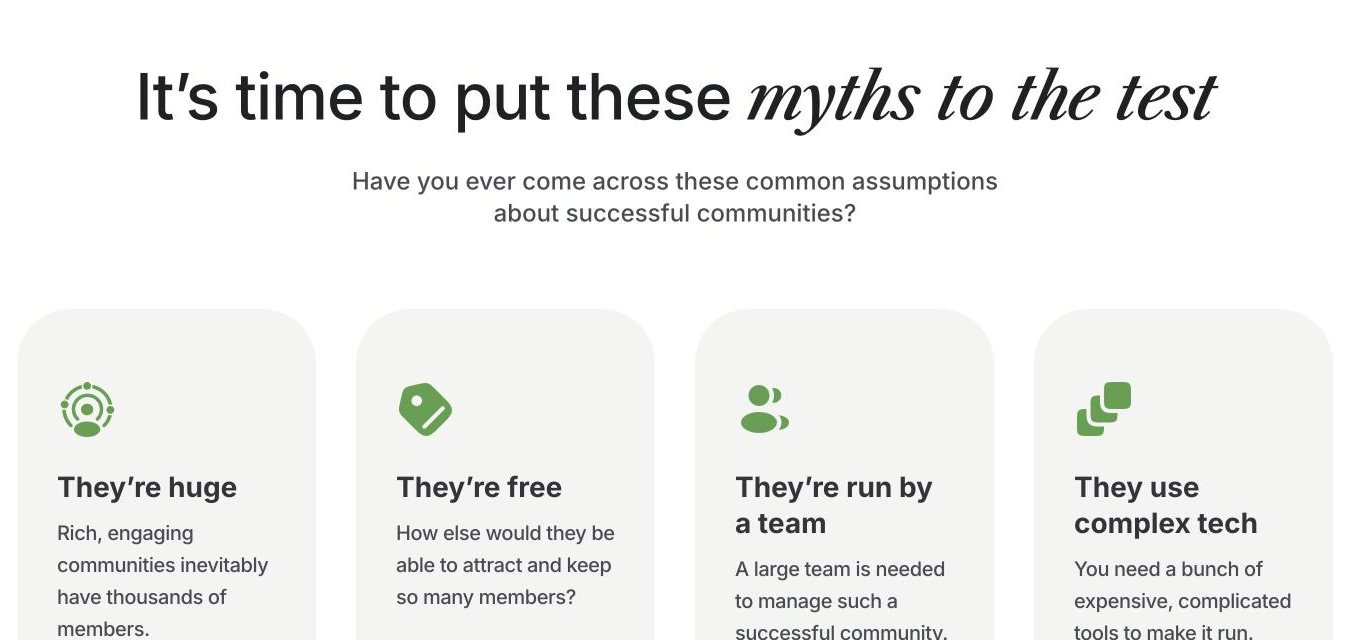
One of my favorite findings was that the most successful communities weren't necessarily the biggest or best resourced. In fact, 75% had 500 members or fewer, and about 60% didn't have any full-time help.
The difference was often in how thoughtfully they engaged and supported their members.
That gave us a much more interesting story to tell than simply publishing a collection of industry statistics.
Launch strategy & enablement
I wanted the report to be more than a piece of content people downloaded once and forgot about. The goal was to make the research useful across the entire customer experience.
So I developed a launch campaign that included announcement emails, in-product messaging, community posts, and a live customer event where we could walk through the findings.
I also created an internal training course and enablement toolkit to help different teams put the research to work.
For Customer Success, that meant giving them benchmarks and questions they could use in business reviews. For Sales, it meant talking points and email templates. And for Marketing, it meant turning individual findings into content and campaigns that could reach new audiences.

The results
The report generated 20,711 landing page visits, 2,806 downloads, and $16.5K in attributed MRR (approximately $200K in ARR).
It also outperformed our previous acquisition-focused summit, which I found particularly exciting given that the idea originally came from trying to solve a customer problem.
For me, it was a great example of how creating something valuable for existing customers can also become a powerful growth strategy.